

Schema Detection
Learn how Validio automatically detects and infers schemas for structured and semi-structured data sources.
Schema detection in Validio automatically derives a schema for every source through metadata reading, inference, or manual configuration, ensuring accurate validation without manual setup.
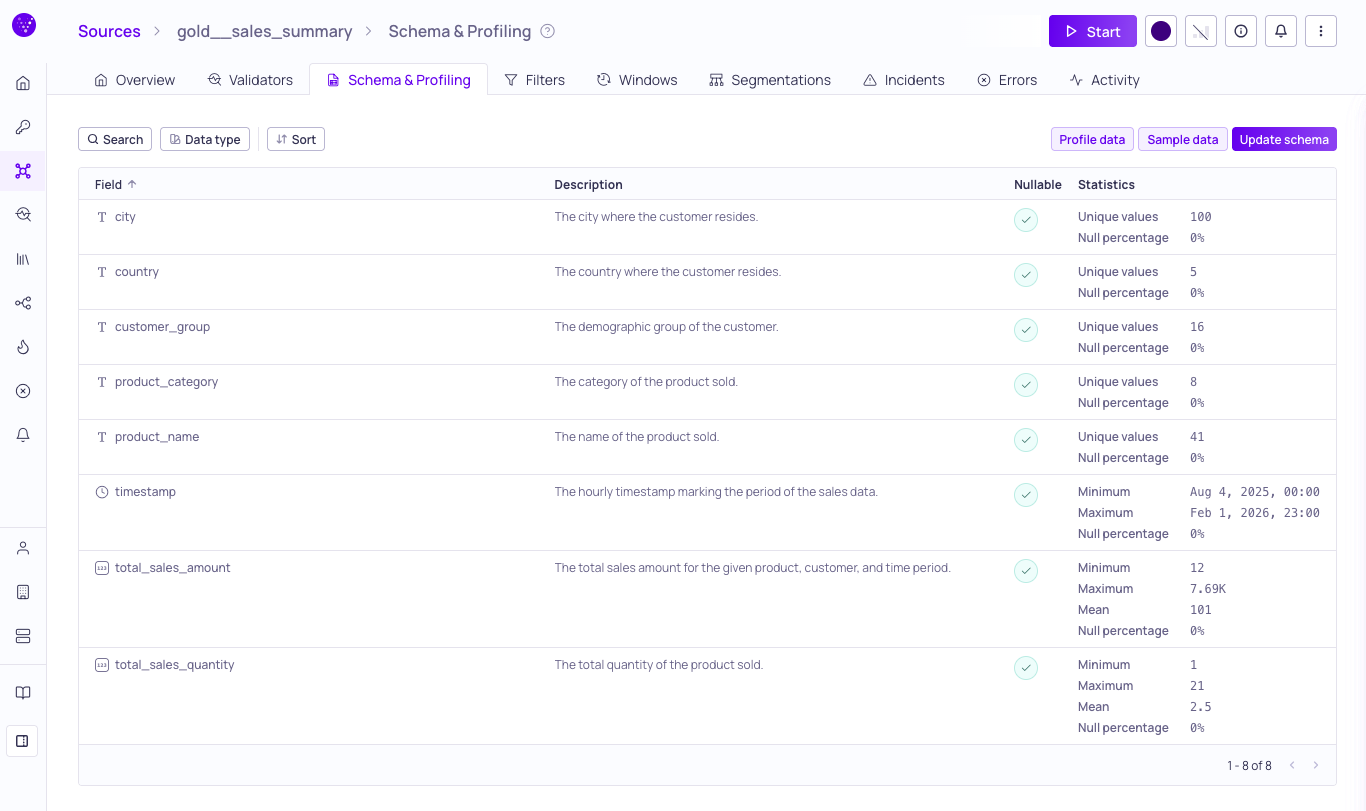
Source schema list with profiling results
Validio derives the schema using three approaches:
- Schema from metadata: For most structured data types, Validio reads the schema from the data source metadata. For example, reading from
INFORMATION_SCHEMAin a data warehouse. - Schema from inference: When a predefined schema doesn't exist, such as for JSON or other semi-structured data types, Validio infers the schema from the existing data patterns.
- Manual configuration: Depending on the data source and types, you can manually configure the schema by selecting fields, including nested fields, for validation.
Supported Complex Data Types
In addition to structured data, Validio supports semi-structured and other complex data types. You can select these fields or nested fields when you configure a source.
Data Warehouses
| Source system | Supported complex data types |
|---|---|
| Athena | ARRAY, MAP, STRUCT |
| ClickHouse | Tuple, Named Tuple, Nested, Array |
| Databricks | STRUCT, ARRAY, VARIANT |
| Google BigQuery | JSON, ARRAY, STRUCT |
| PostgreSQL | JSON, JSONB, Array |
| Redshift | SUPER |
| Snowflake | ARRAY, OBJECT, VARIANT |
Data Streams
| Source system | Supported complex data types |
|---|---|
| Kafka | JSON, Protobuf, Avro |
| Kinesis | JSON, Protobuf, Avro |
| Pub/Sub | JSON, Protobuf, Avro |
JSONPath Expressions and Arrays
Currently Validio does not support data validation within an array. However, you can validate the size of an array.
Validio uses JSONPath expressions to represent data structures. For each array, Validio adds a computed numeric field named
some_array.length()to represent the size of an array.
Understanding Nullable Fields
If the automatically inferred schema doesn't match your expectations for incoming data, you can modify the nullability settings and data types to better reflect your data structure.
- Check the
Nullableoption to include datapoints withNULLvalues in validation. - When unchecked, datapoints with
NULLvalues in that field will be excluded from validator metrics.
This gives you control over how missing or null data affects your validation results.
When Automatic Detection Fails
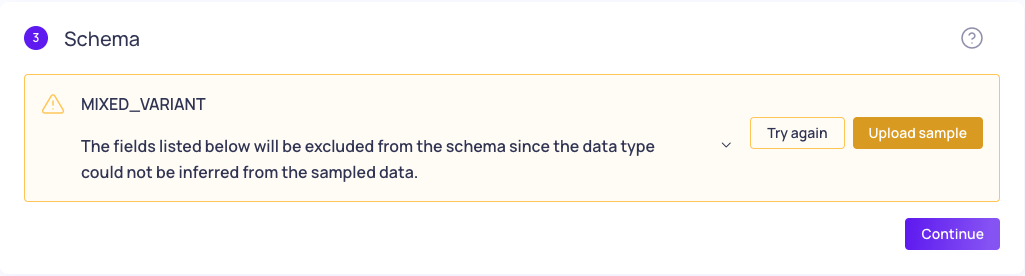
Schema detection error with option to Upload sample data file.
Schema inference may encounter issues in these scenarios:
- Large tables: Timeout occurs when source tables are too large to process efficiently
- Unknown data types: Cannot determine appropriate data types for schema fields
- Mixed data types: Semi-structured data with inconsistent data types across rows
Upload a JSON sample
When automatic detection fails, upload a JSON sample file to help Validio understand your schema structure.
Sample data format:
{
  "date": "2025-01-01",
  "user_id": 123,
  "user_profile": {
    "age": 20,
    "name": "Bob"
  }
}Case Sensitivity: The properties (fields and values) used in the uploaded sample data file must match the case conventions of your data source. For example, Snowflake defaults to uppercase, so your sample data should use uppercase field names.
Schema Change Validation
Validio automatically validates schema changes for structured data in data warehouses and object storage files. Validio runs schema checks hourly, and reports detected changes as source errors, not incidents. You can review them on the source's Schema tab, and receive notifications for them with a notification rule of the Schema change type. For more information, see About Source Errors and Adding Notification Rules.
Updated 20 days ago