

Configuring Global Settings
Configuration options for customizing your Validio installation.
Global settings let you configure system-wide options for your Validio environment, such as workspace display, default user roles, and your installation's application URL. Manage them under the Workspace > Settings tab.
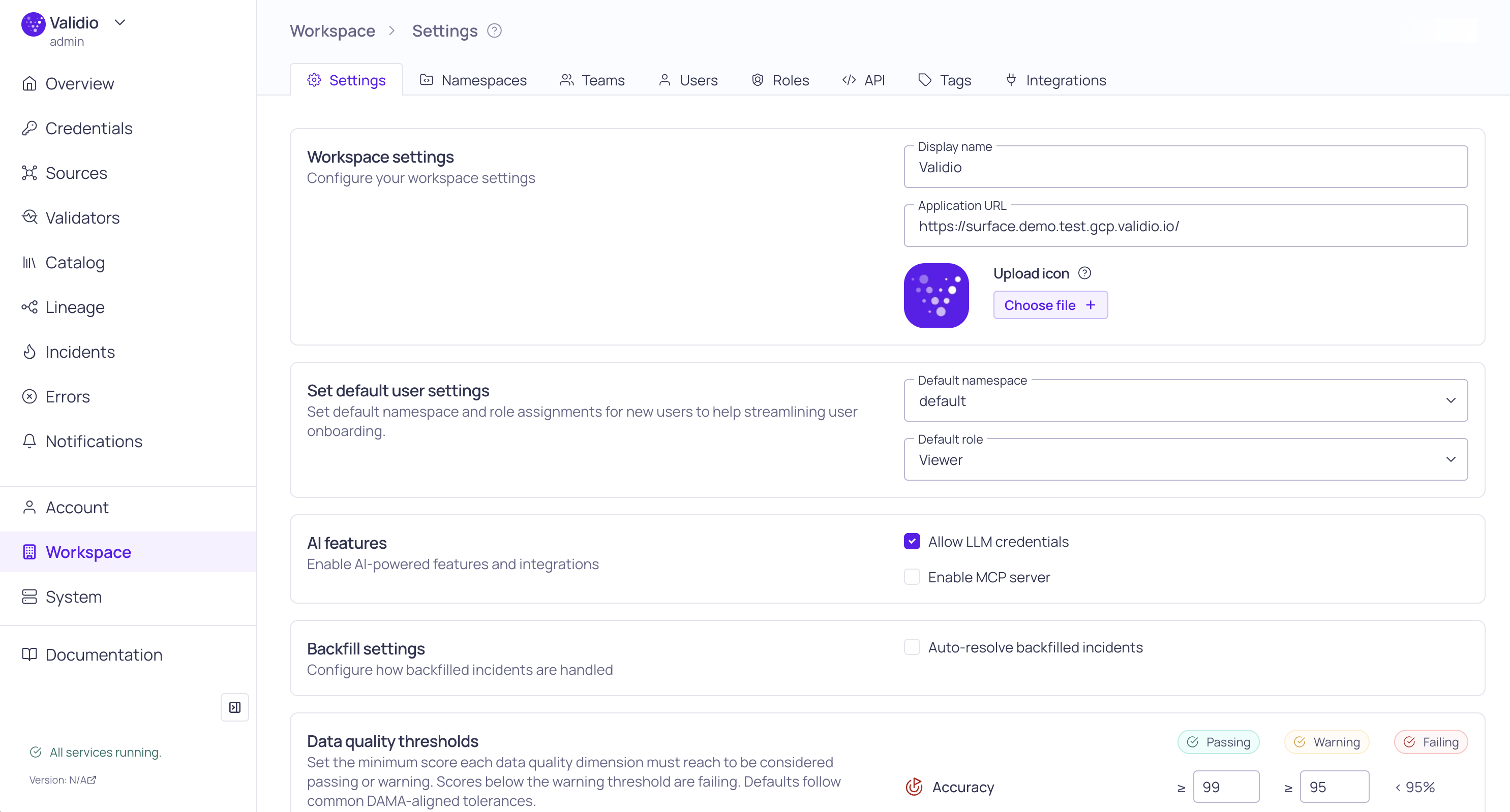
Global and Workspace Settings
Editing the workspace settings requires global
settings:WRITEpermissions. See Managing Roles.
Workspace Settings
Customize the Workspace settings in your Validio environment.
| Setting | Description |
|---|---|
| Display Name | An identifier for your Validio environment. |
| Application URL | The URL for your Validio installation or deployment instance. This setting is required for creating notification channels, sharing links into your environment, and enabling AI features. |
| Upload Icon | Display your company logo, or a custom icon, on the Validio login and main application pages. |
Default User Settings
The default user settings allow you to streamline the initial setup process for users. You can set a default namespace and assign a default role, ensuring that newly created users have access to the correct workspace when they first log in.
| Setting | Description |
|---|---|
| Default Namespace | Set a namespace to automatically assign to all new users. |
| Default Role | Set a role to automatically assign to all new users. |
AI Features
The AI Features setting lets you enable AI-powered features and integrations on your Validio installation.
- Allow LLM Credentials - Configure credentials for external Large Language Model (LLM) providers to compose and correct custom SQL queries in validators and filters. See LLM Credentials.
- Enable MCP Server - Integrate with the Validio MCP server. You will not be able to enable the MCP server if you do not set an Application URL for your Validio installation. Connected AI assistants inherit the permissions of the connecting user, and destructive operations are always refused. See Validio MCP Server.
Backfill Settings
Configure how backfilled incidents are handled in your Validio environment.
- Auto-resolve backfilled incidents — When enabled, incidents generated during a backfill (such as a validator reset, rerun, or initial start with backfill) are automatically resolved. Since resolved incidents are excluded from the data quality score, this prevents historical reprocessing from negatively impacting your data quality metrics.
Data Quality Thresholds
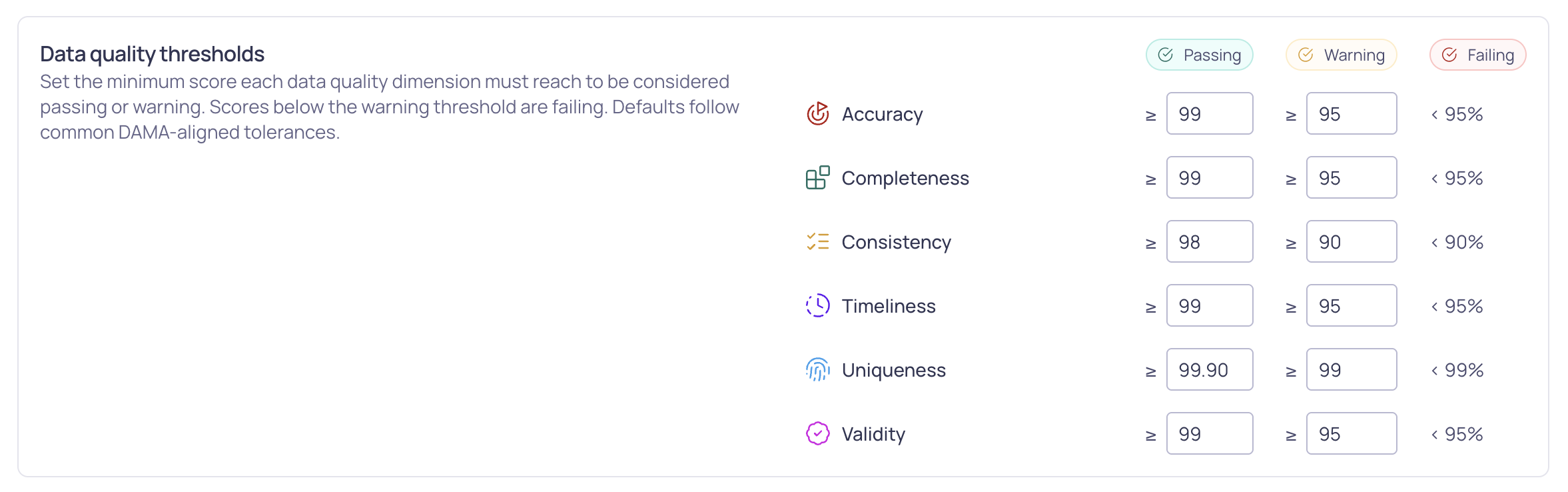
The Data quality thresholds setting controls the per-dimension passing/warning/failing bands used across the catalog — on the glossary term data quality tab, in classification coverage rollups, and in the data quality dots on the glossary list.
For each data quality dimension (Completeness, Validity, Timeliness, Accuracy, Consistency, Uniqueness), set:
- Passing -- The minimum score the dimension must reach to be considered passing. Scores at or above this value are reported as green.
- Warning -- The minimum score the dimension must reach to be considered warning. Scores at or above this value but below the passing threshold are reported as yellow. Scores below the warning threshold are failing (red).
Both thresholds are percentages between 0 and 100. The passing threshold must be greater than the warning threshold. Defaults follow common DAMA-aligned tolerances and can be tuned per workspace.
Threshold changes save immediately and apply the next time data quality scores are recalculated across the catalog.
Diagnostic Settings
Under the diagnostic settings, you can opt-out of tracking by third-party integrations.
- Allow tracking of application usage - Application usage allows Validio to track information about how you use our product and where you may have issues.
- Allow collecting error logs - Error logs allow us to track when our product has issues in your environment.
Updated about 1 month ago