

Adding Notification Rules
Learn how to configure conditions on a channel to trigger alerts in Validio.
Notification rules define the conditions that trigger alerts in Validio and live inside a notification channel. Open the channel's details page to create rules, edit their conditions, and see which incidents have triggered them.
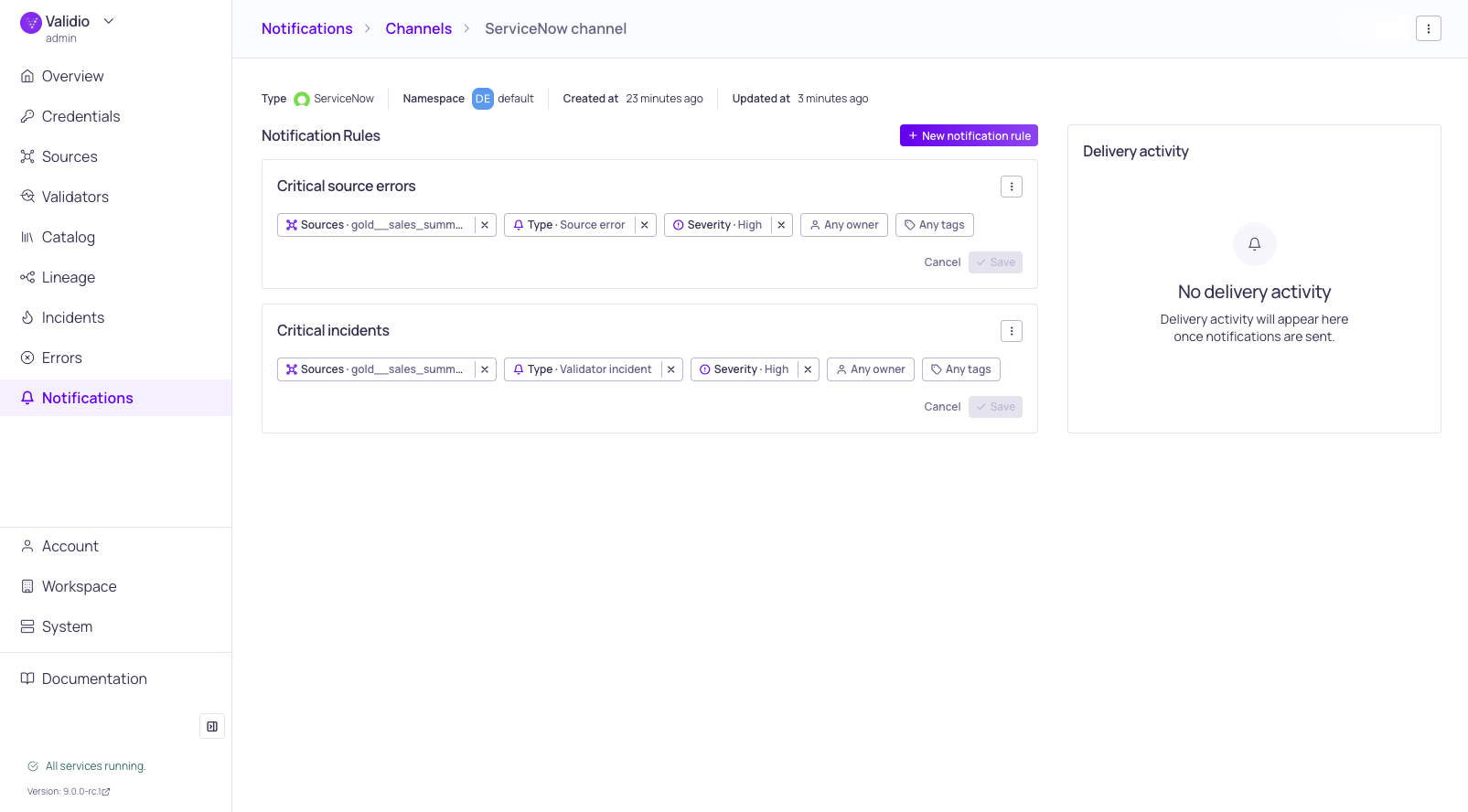
Notification rules on a channel details page
Each rule belongs to exactly one channel. You view and manage a channel's rules from the Notification rules section of its details page. Each rule renders as a card with its name and a row of condition chips — Source, Type, Severity, Priority, Segment, Owner, and Tags. Click any chip to set its value; empty chips show Any source, Any type, Any severity, Any priority, Any segment, Any owner, or Any tags. Click Save to apply your changes, or Cancel to discard them. Use the ⋮ menu next to each rule to Rename or Delete the rule.
On Slack and Microsoft Teams channels, the rule card also shows a Mention owners in notifications toggle below the condition chips. See Mention Owners in Notifications.
Notifications on Backfilled Validators
Validio does not send notifications for incidents when backfilling validators.
Add a New Rule
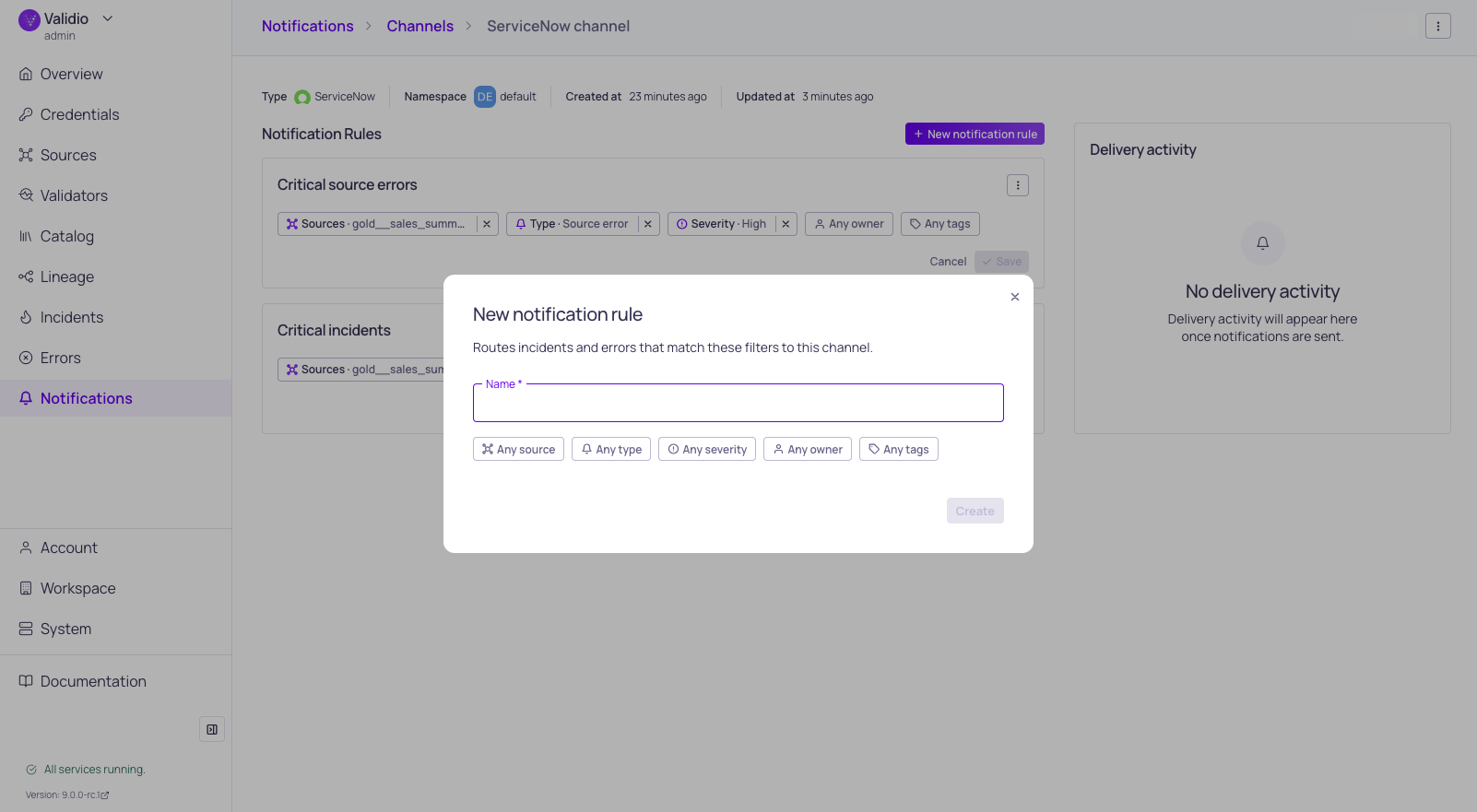
New notification rule configuration
Follow these steps to create a new notification rule on a channel.
- In Validio, navigate to Notifications > Channels and click the channel that should receive the alerts.
- In the Notification rules section, click + New notification rule.
- Enter a descriptive Name for the rule, such as "High severity production incidents".
- In the same dialog, set at least one condition chip (Source, Type, Severity, Priority, Segment, Owner, or Tags). Click + Add tag condition or + Add segment condition to add another tag or segment chip after the first one has a value. See Configuration Options for Conditions for the supported condition types.
- (Optional, Slack and Microsoft Teams channels only) Turn on Mention owners in notifications to tag the incident owner in the messages this rule sends. This toggle is not a condition, so it does not count toward the one required condition. See Mention Owners in Notifications.
- Click Create. The button stays disabled until the rule has a name and at least one condition.
A notification rule requires at least one condition. Use the chips to narrow the rule to the incidents you care about — for example, set the Severity chip to
HighandCriticalto alert only on serious incidents.
Configuration Options for Conditions
Conditions let you filter which incidents trigger a notification on the rule's channel. Validio supports the following condition types:
| Condition Type | Description | Configuration Options |
|---|---|---|
| Owner | Send notifications based on who owns a source. Owners can be assigned on the Sources and Source Details pages. | Select from a list of Owners. |
| Priority | Send notifications based on incident priority. Priority is inherited from the source or validator. Only validator incidents have priority. For more information, see About Validator Incidents. | Low Medium High Critical |
| Segment | Send notifications only on incidents in selected segments. Each row in a segment chip pairs a Segment field name with a Regex pattern that is matched against the segment value. A rule can hold one or more segment conditions. Click + Add segment condition on the rule card to add another segment chip. The segment chips combine using DNF logic — see Tag and Segment Conditions (AND within, OR across) for details. | Segment field Regex pattern |
| Severity | Send notifications based on their severity. Only validator incidents have severity levels. For more information, see About Validator Incidents. | Low Medium High |
| Source | Send notifications only when incidents are generated by selected sources. | All sources Select from a list of specific Sources |
| Tag | Send notifications when incidents occur on sources or validators containing the selected pre-defined tags. You can only route notifications based on Label tags. A rule can hold one or more tag conditions. Click + Add tag condition on the rule card to add another tag chip. The tag chips combine using DNF logic — see Tag and Segment Conditions (AND within, OR across) for details. For example, to notify on incidents from a specific validator on a source, tag that validator and add a tag condition to the rule for that tag. | Label Custom |
| Type | Send notifications when the selected type of issue occurs. | Schema change Validator incident Source errors Source segment limit exceeded |
Mention Owners in Notifications
Mention owners in notifications is a per-rule option that @-mentions the incident owner in the messages the rule sends, so the person responsible is pulled into the conversation instead of having to spot a channel post. The option is available on Slack and Microsoft Teams channels only, and it is turned off by default, so existing rules keep sending untagged messages until you enable it.
This option is not the same as the Owner condition. The Owner condition filters which incidents trigger the rule, based on who owns the source. Mention owners in notifications controls who is tagged in the message the rule sends. You can use either one on its own, or both together.
Enable Owner Mentions on a Rule
- In Validio, navigate to Notifications > Channels and click the Slack or Microsoft Teams channel that owns the rule.
- In the Notification rules section, locate the rule and turn on the Mention owners in notifications toggle below its condition chips.
- Click Save.
You can also set the toggle while creating a rule, or on the default rule in the + New channel dialog. The toggle appears only after you select a Slack or Microsoft Teams integration; if you switch to an integration that cannot mention users, the setting is cleared.
How Tagged Messages Appear
When the rule triggers and the option is enabled, Validio adds an Owner entry containing an @-mention of the owner:
- In Slack, the mention appears in the incident message posted to the thread, alongside fields such as Data time, Value, and Deviation.
- In Microsoft Teams, the mention appears as an Owner line in the incident card.
You do not need to enable Interactive messages on the integration to use owner mentions.
Requirements and Limitations
- Matching is by email address. Validio tags the owner by matching the email address on their Validio user account to a user in your Slack workspace or Microsoft Teams tenant. If the two addresses differ, no match is found.
- No owner, no mention. If the source or validator that generated the incident has no owner assigned, the notification is sent without a mention.
- No match, no mention. If the owner has no matching Slack or Teams user, the notification is still sent — it simply arrives without a tag, and no error is reported.
Validators inherit the owner of their source unless the validator has its own owner. To assign or change an owner, see Updating the Owner.
Combining Condition Types
The logic applied to a notification rule depends on the condition type and on whether values are combined within a single chip or across multiple chips.
Across Different Condition Types (AND logic)
When a rule sets values on more than one condition type — for example, both a Source chip and a Severity chip — AND logic is applied across them. All chips must match the incident before the notification triggers.
Multiple Values within Source, Type, Severity, Priority, or Owner (OR logic)
The Source, Type, Severity, Priority, and Owner chips each accept multiple selections. Within one of these chips, OR logic is applied: the chip matches if the incident matches any of the selected values. For example, selecting both High and Critical on the Priority chip notifies on incidents at either priority.
Tag and Segment Conditions (AND within, OR across)
Tag and segment conditions follow a two-level logic so you can express complex routing rules:
- Within a single tag or segment chip — AND logic. All tags selected in one tag chip must be present on the source or validator that generated the incident. Similarly, every
Segment field/Regex patternrow in one segment chip must match the incident's segment. - Across multiple tag or segment chips — OR logic. A rule with several tag chips matches the incident if any one of those chips matches. The same applies to segment chips.
For example, a rule with a single tag chip containing env:prod and team:data only fires when the source or validator has both tags. Click + Add tag condition to add a second tag chip with, say, region:us-east; the rule then matches an incident tagged either (env:prod and team:data) or region:us-east. Segment chips work the same way: a chip with rows country = ^US$ and tier = ^gold$ matches only incidents on the US gold segment, and adding a second segment chip introduces an alternative match using OR.
Edit or Delete a Rule
To change the conditions on an existing rule:
- Open the channel at Notifications > Channels > channel name.
- In the Notification rules section, locate the rule and click a condition chip to change its value. To add another tag chip, click + Add tag condition. To remove an added tag chip, click its X.
- Click Save to apply your changes, or Cancel to discard them and revert the chips to their previously saved state. On Slack and Microsoft Teams channels, the Mention owners in notifications toggle is saved and discarded by the same buttons.
To rename a rule, click Rename from the rule's ⋮ menu, enter a new name, and confirm.
To delete a rule, click Delete from the rule's ⋮ menu and confirm the deletion. Deleting a rule stops any alerts from being sent for the conditions it defined, but other rules on the same channel continue to trigger.
Updated about 1 month ago