

About Credentials
Credentials store the authentication details that connect Validio to your data warehouses, BI tools, and integrations.
Credentials store the authentication details that connect Validio to your data warehouses, business intelligence tools, and other integrations.
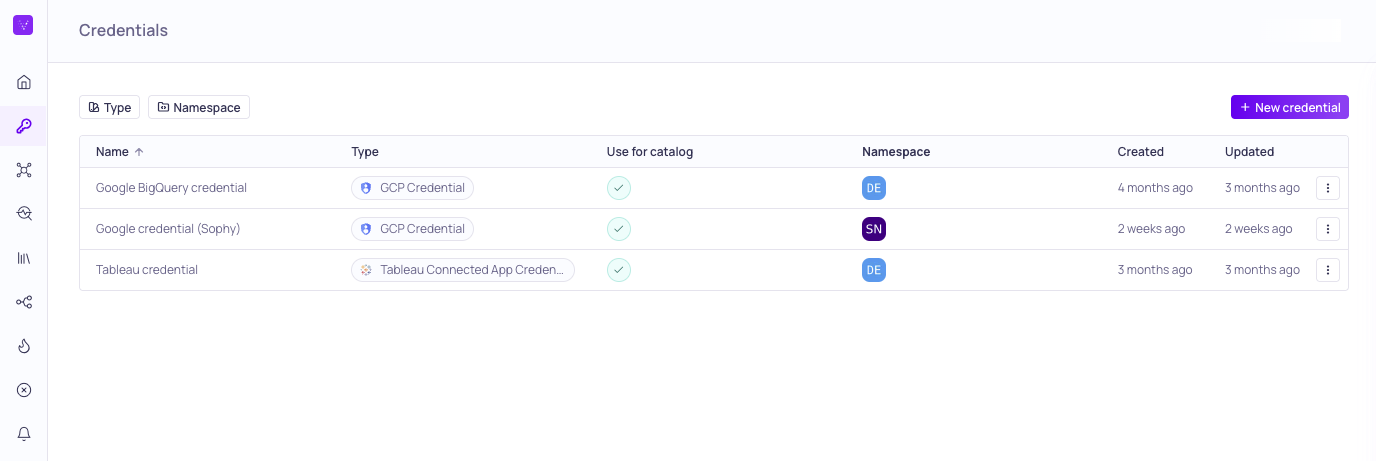
Credentials page with table of existing credentials
Credentials connect Validio to the data that you want to monitor. For data warehouses, the credentials store the authorizations details for the user or service accounts you will use to connect Validio to data sources and other integrations. For business intelligence tools, credentials are used to populate catalog assets and lineage graphs.
How Credentials Work
Most credential configurations require a set of parameters, such as a username, password, and host name of a service account that you will use to access the data. For credentials that will connect to a warehouse, you might also need to specify the default database where the data is stored or the role used to access the data source.
After you create a credential, Validio will connect to the service account and automatically start to collect information, such as metadata and lineage. If the credential is used for catalog and schema checks, this information populates the catalog and lineage pages with assets. You can convert assets discovered from data source credentials to sources for Validio to monitor and validate.
For more information, see Managing Credentials.
Credential Permission Requirements
Validio Credentials require
VIEWERaccess rights when connecting to sources to read and access data. Admins must ensure that they do not provideEDITORaccess rights to their credentials.
Credential Types
The following is a list of credential types. You can find instructions to configure each credential on their dedicated integration pages.
BI Tools Credentials
Connect Validio to Business Intelligence Tools.
Data Catalog Solutions
Connect Validio with data catalog solutions.
| Credential Type | Supported Integrations |
|---|---|
| Atlan | Atlan |
Data Source Credentials
Connect Validio to data sources, such as warehouses, streams, transformation tools, and transactional databases.
| Credential Type | Supported Integrations |
|---|---|
| AWS | Kinesis |
| AWS Athena | Athena |
| AWS Redshift | AWS Redshift |
| Azure Synapse Entra ID | Azure Synapse |
| Azure Synapse SQL | Azure Synapse |
| ClickHouse | ClickHouse |
| Databricks | Databricks |
| dbt Cloud | dbt Cloud |
| dbt Core | dbt Core |
| Google Cloud Platform (GCP) | Google BigQuery, Pub/Sub |
| Kafka SASL SSL Plain | Kafka |
| Kafka SSL | Kafka |
| Microsoft SQL Server | SQL Server |
| Oracle | Oracle |
| PostgreSQL | PostgreSQL |
| Snowflake | Snowflake |
| Teradata | Teradata |
LLM Credentials
Connect Validio to Large Language Model (LLM) providers to enable AI Features, such as Generating SQL in Validators and Filters.
| Credential Type | Supported Integrations |
|---|---|
| Amazon Bedrock | Amazon Bedrock |
| Anthropic | Anthropic |
| Gemini Enterprise | Gemini Enterprise |
| Microsoft Foundry | Microsoft Foundry |
| OpenAI | OpenAI |
Best Practices
When setting up credentials for your organization, you can use Namespaces to control access (view and edit privileges) to the credentials. The following are general guidelines and recommendations.
- Visibility into global Catalog and Lineage views: Configure a single credential with “Use for catalog and schema checks” enabled to populate your global catalog and lineage views so that it is visible for all of your organization’s users in Validio. This credential should be assigned to a namespace that only the admin has access to and it should not be used for creating new sources.
- Dedicated Namespaces with limited visibility and permissions: For individual teams and business units, create dedicated namespaces to ensure that the users and teams with Editor access to the namespace can only create sources and run debug queries off of the credentials in the namespace. You do not need to enable cataloging or schema checks on these credentials if you have enabled a global credential.
- Distinguish between Editor and Viewer access: Ensure that teams and users have access to what they need to see. Different teams can configure and manage their own resources separate from other teams.
Updated 3 months ago