

Alerting on Incidents
Configure notification channels and rules in Validio to alert your team about critical data quality incidents.
After Triaging Critical Incidents, setting up proper alerting ensures your team is notified immediately when critical incidents or anomalies are detected in your data. In Validio,
- Notification channels send messages to communication tools like Slack or Microsoft Teams. Each channel references an integration that stores the connection credentials for the external service.
- Notification rules define the conditions that trigger alerts, and live inside a channel.
If you are already using Slack for team collaboration, routing Validio alerts to a Slack channel provides seamless integration with your existing workflow. In this tutorial, you will create a Slack integration, add a channel, and add a rule that alerts you on critical incidents.
Prerequisites
This part continues from Triaging Critical Incidents and assumes you completed the tutorial prerequisites.
Before you can send notifications to Slack, create and configure a Slack app for Validio. The app setup produces the credentials the Slack integration uses: a Bot token, and — if you want to triage incidents directly from Slack — an App-level token with Socket Mode enabled. The app must be invited to the Slack channel that will receive notifications. See Setting up a Slack App for Validio.
Create a Slack Integration
A Slack integration stores your Slack app credentials once so you can reuse them across multiple channels.
- Navigate to Workspace > Integrations and click + New integration.
- From the Integration type list, select Slack.
- Enter a Name for the integration, for example "Production Slack".
- Enter the Bot token from your Slack app.
- (Required for this tutorial) Enable Interactive messages so your team can triage incidents directly from Slack. When enabled, the App-level token field is required — enter the App-Level Token you generated for your Slack app.
- (Optional) Click Test integration to verify the connection.
- Click Create integration.
Add a Notification Channel for Slack
A notification channel points your Slack integration at one specific Slack channel.
- Navigate to Notifications > Channels and click + New channel.
- Under Integration, select the Slack integration you created.
- Enter a Name for the channel. You use this name when you reference the channel from notification rules.
- Enter the Slack channel ID of the destination channel in your Slack workspace. You can find the channel ID in the Slack channel's details.
- Select the Namespace where the channel will be created. Only users assigned to the same namespace can access this channel.
- Click Create.
Once your channel is configured, add a rule that defines which incidents trigger an alert.
Add a Notification Rule to your Channel
Notification rules live on a channel's details page and use condition chips to filter which incidents trigger an alert. Follow these steps to route critical incidents to your Slack channel.
- Navigate to Notifications > Channels and click the channel you just created to open its details page.
- In the Notification rules section, click + New notification rule.
- Enter a Name for the rule, such as "Critical Incidents".
- Set the condition chips that an incident must match for the rule to send a notification:
- Set the Type chip to Validator incident.
- Set the Severity chip to High.
- Click Create. The button stays disabled until the rule has a name and at least one condition.
The rule now appears on the channel with its Type and Severity chips, and alerts will trigger the next time a matching incident is detected.
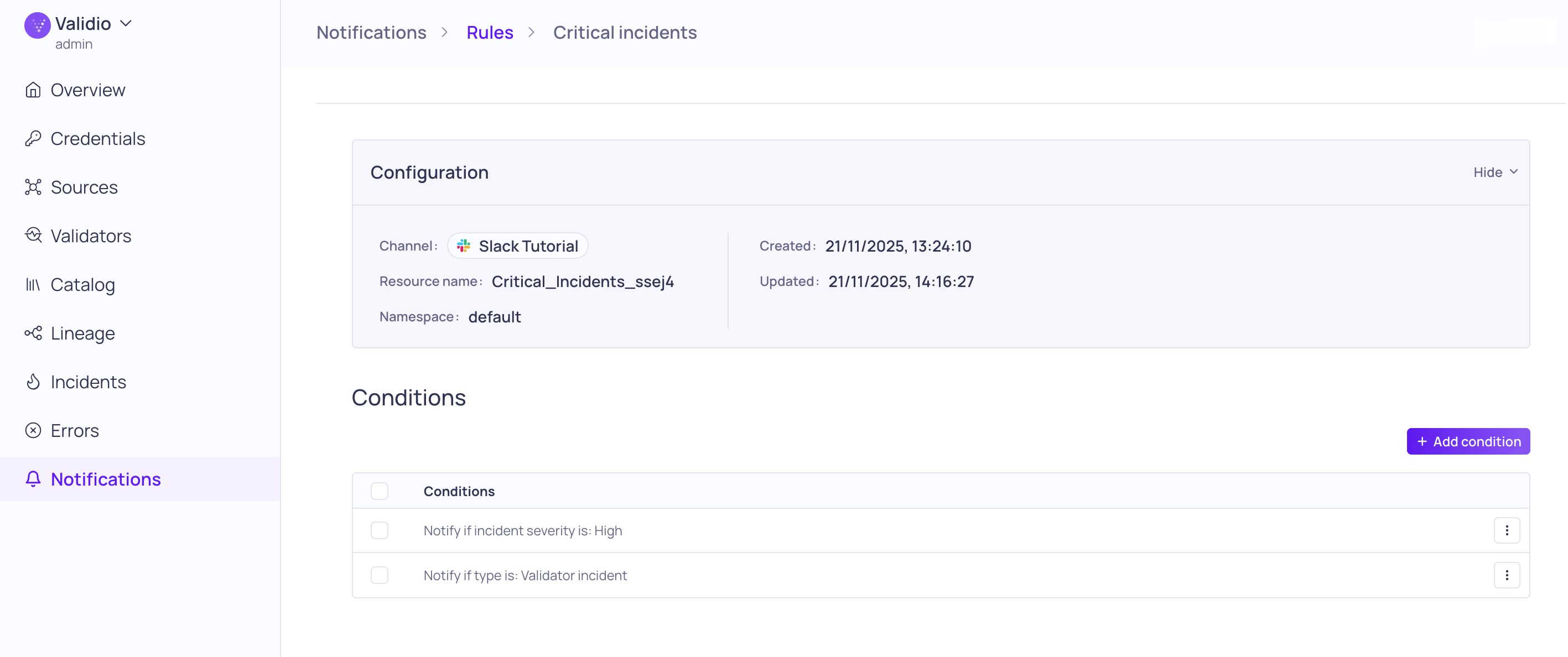
Configuration and conditions for "Critical Incidents"
Reviewing and Interacting with the Notification
When a critical incident triggers your notification rule, your team will receive a comprehensive alert message in the designated Slack channel. Understanding what information is included in these notifications helps ensure your team can respond quickly and effectively.
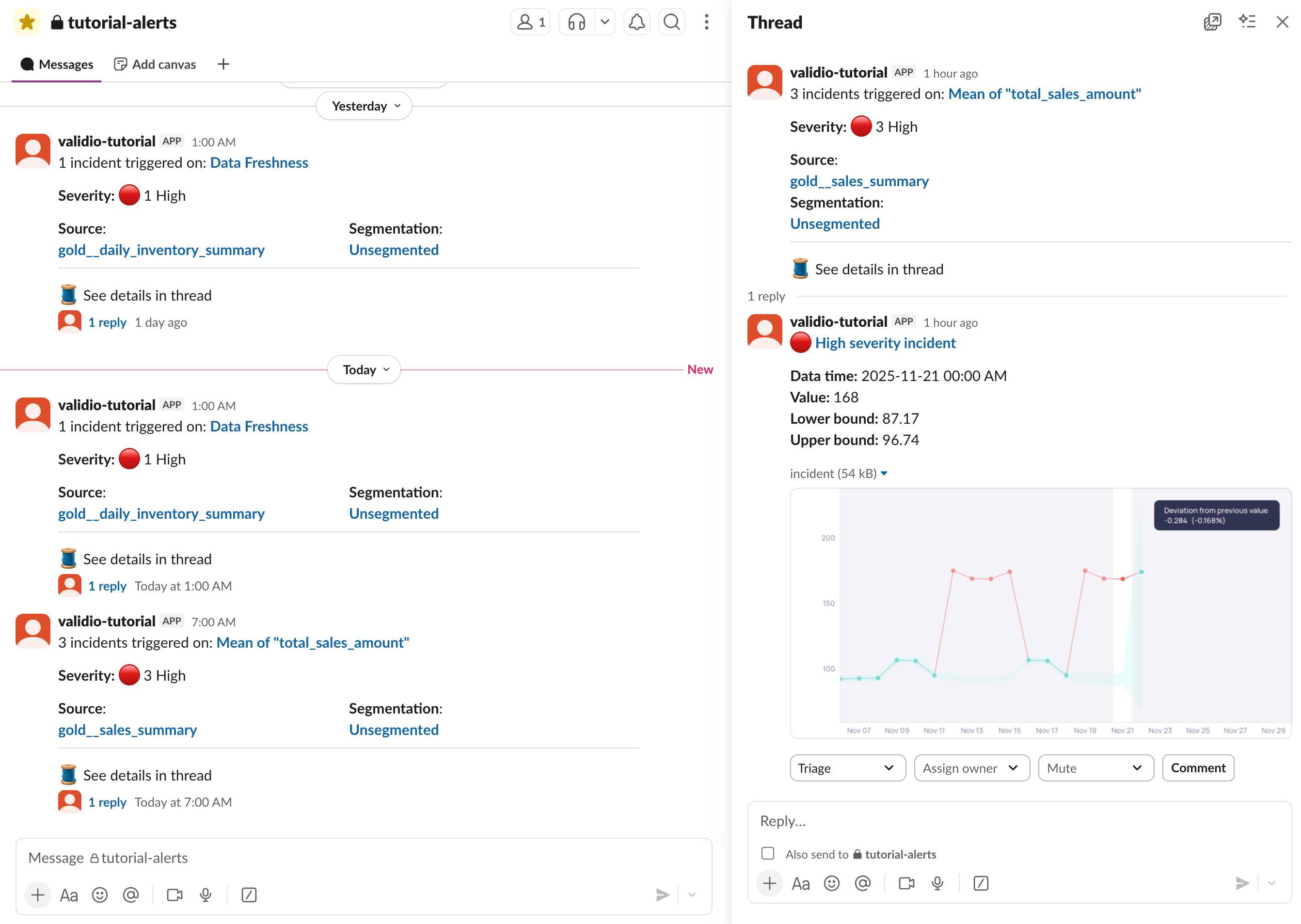
Reviewing details for a "Critical Incidents" notification
Each notification message provides essential details to help your team assess and respond to incidents.
- Review the Incident summary, which includes:
- Title: Indicates the number of incidents and which validation check failed, 3 incidents triggered on Mean of "total_sales_amount"
- Severity Level: Visual indicator showing the urgency (High, Medium, Low)
- Source and Segmentation: Which system or dataset is affected
- Timestamp: When the incident was detected
- Metric graph: Shows the current incident group as well as past, if there are any
- Impact assessment: A tooltip in the metric graph provides a brief description of what data quality issue was detected.
- Since you enabled Interactive Messages during channel setup, team members can take immediate action directly from the Slack notification:
- View Details: Opens the full incident report in Validio
- Acknowledge: Update the status from Triage to Investigating to mark that someone is taking this action
- Assign owner: Designate a team member to handle the incident
- Add Notes: Add comments and include initial observations or next steps. These comments will sync to the Activity log for the incident group within Validio.
- Follow up with your investigation within Validio. See Triaging Critical Incidents.
Validio's alerting is designed to keep you informed without causing alert fatigue. For more information, see About Notifications.
Next Steps
You have completed the Getting Started Tutorial. You set up a source, added a validator to monitor and validate your data, investigated and triaged incidents with Root Cause Analysis, and configured Slack alerting so your team is notified when critical incidents are detected.
From here, you can go deeper on the areas most useful to your team:
- Add more validators to the same source, or let Validio propose them — see Validator Recommendations.
- Explore your data relationships and impact with Data Catalog and Data Lineage.
- Set up namespaces and roles to control who can access what — see About Validio RBAC.
Updated 3 months ago