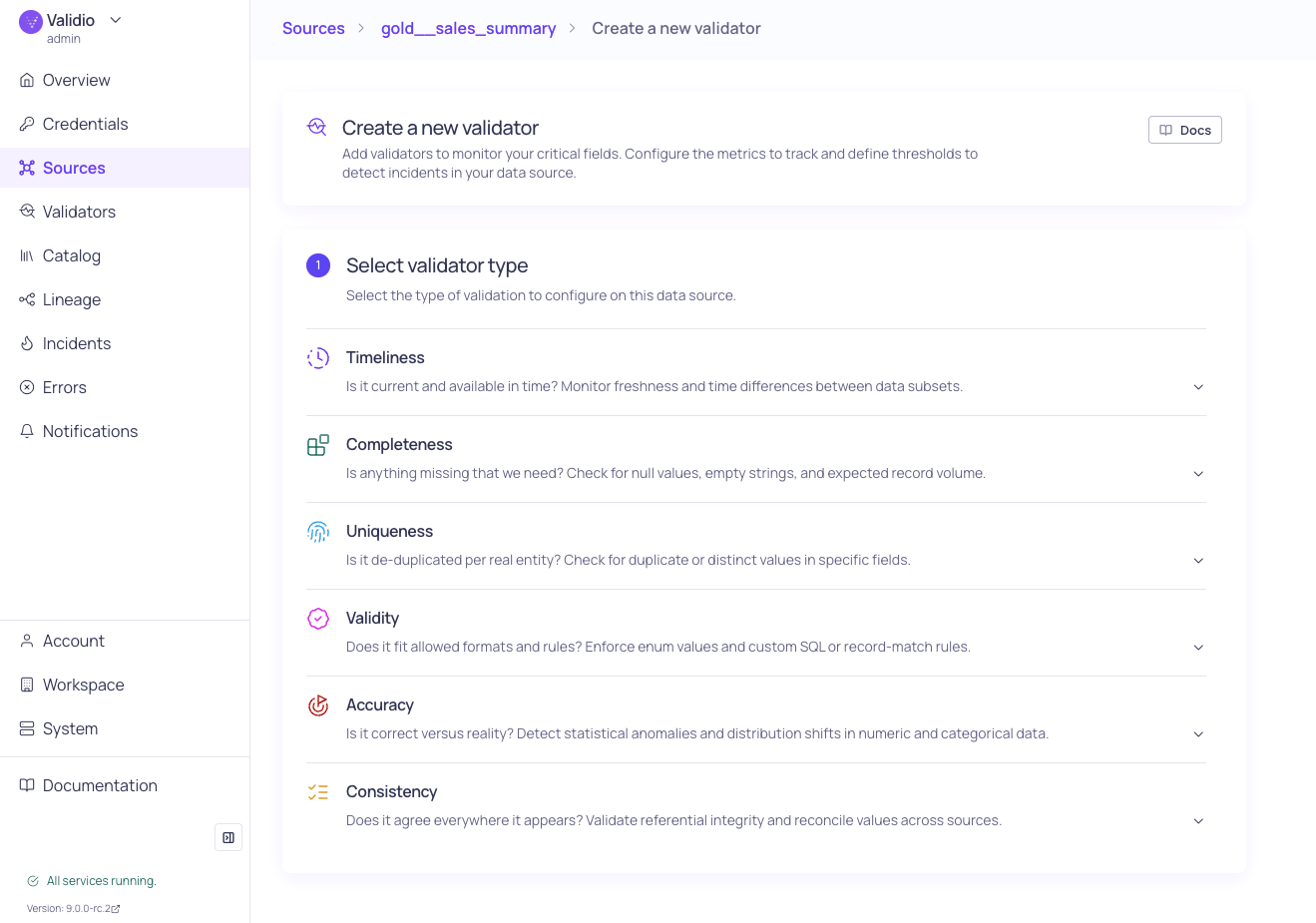
A validator is a check that calculates a metric on your data over a window and compares it against an expected threshold to detect data quality issues. A validator type defines the specific check a validator performs, and Validio organizes validator types by data quality dimension: timeliness, completeness, uniqueness, validity, accuracy, and consistency.
The validator type picker shown when creating a new validator on a source

Validator type options when creating a new validator on a source

This guide lists the different validator types and supported metrics for each validator.
Validator Metrics and Windows: Validators calculate metrics over a window. For example, a validator calculates the mean value over a daily window, and then validates if these daily mean values follow an expected seasonal pattern. See About Validators and Configuring Validators.

Timeliness

Verify that data is up-to-date and that events arrive within the expected timeframe.

Completeness

Ensure datasets contain the expected data by checking for null values, empty strings, missing records, and overall data volume.
Metadata Validators for Data Warehouse Sources Freshness (metadata) is available for BigQuery and Snowflake sources, and Row Count (metadata) is available for BigQuery, Snowflake, and SQL Server sources. See Metadata.

Uniqueness

Maintain data quality by checking for duplicate or distinct values in specific fields.

Validity

Verify that data conforms to expected formats, allowed values, and custom business rules.

Accuracy

Evaluate numeric and categorical data to verify it matches expected statistical patterns and distributions.

Consistency

Ensure data remains aligned across validators, sources, or datasets by comparing metrics and record-level consistency.

Reference source validation

Validators are either single source or reference. Single source validators calculate metrics based on one dataset, while reference source validators calculate metrics based on fields from two different datasets (sources). You can only configure a reference source for specific validator types that support comparative analysis (such as Categorical Distribution, Numeric Distribution, and Relative Volume). Reference source validators only calculate metrics if there is data in the target dataset. For example, a Categories removed validator where the reference dataset has 4 categories and the target dataset has 3 categories, yields a result of 1. If the target dataset has 0 categories, the validator does not return any result, because the target dataset has no data to calculate metrics on. For more information and configuration examples, see Reference Source Validation.