

What the activity log records
The activity log captures lifecycle and management actions across Validio resources — sources, validators, credentials, segmentations, windows, filters, incidents, glossary terms, domains, classifications, namespaces, users, teams, roles, API keys, notification channels, notification rules, and tags. Beyond the standard create, update, and delete actions, the log records resource-specific actions, including:- Sources — started, stopped, polled, backfilled, reset, muted, and owner changed.
- Validators — re-run, reset, muted, owner changed, and metric retrained.
- Incident groups — status updated, owner assigned, muted, and comment added.
- Credentials — catalog refreshed.
- Namespaces — roles granted and revoked.
- Glossary terms — resource added and removed, and classification added and removed.
- Domains — archived, restored, and owner changed.
- Classifications — archived, restored, and owner changed.
- Approval workflows — draft created, edited, submitted for review, withdrawn from review, changes requested, approved, and discarded, and archival or restoration requested. The submission and the decision are separate entries, and decisions include the reviewer’s comment. These entries are recorded for namespace and catalog approval workflows alike. See Approval Workflows.
Where the activity log appears
The same activity log is presented in several places, each scoped to a different part of the product. A global view appears on the Overview dashboard, and scoped views appear on individual resource pages.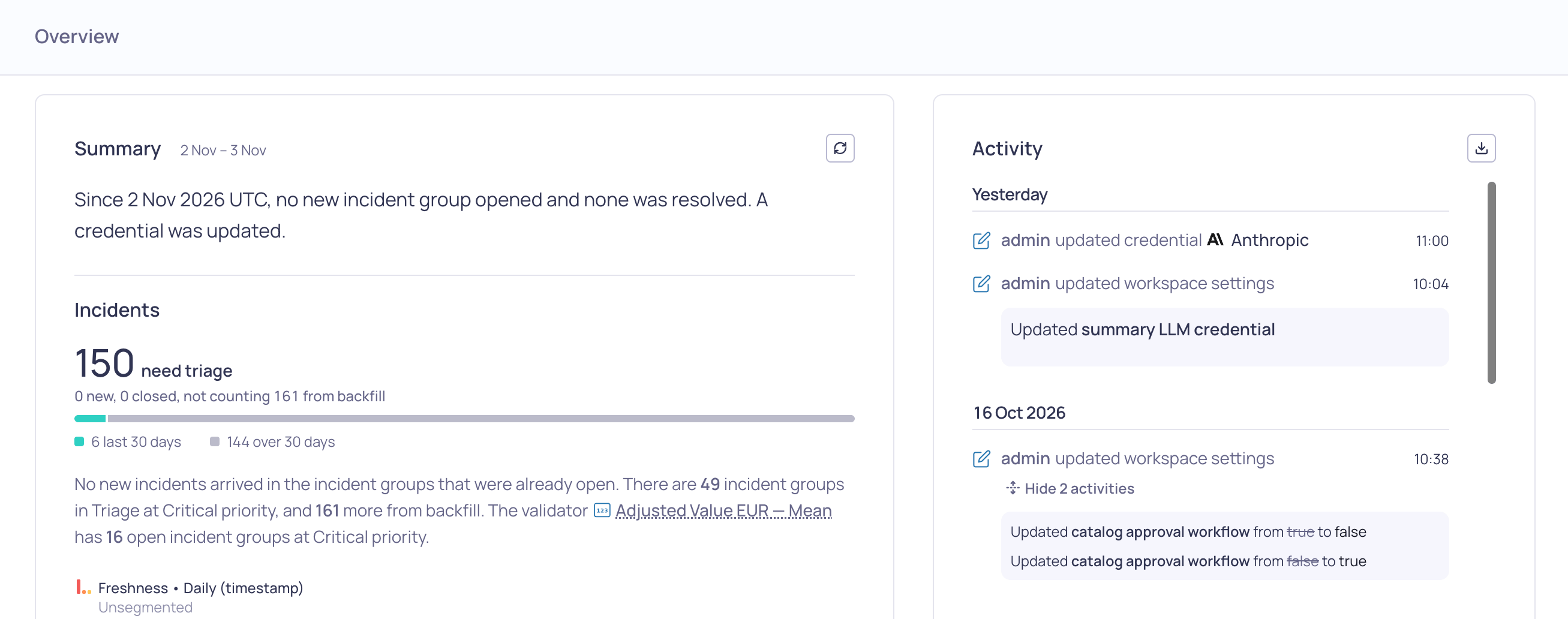
The global activity log in the Activity panel on the Overview dashboard
Activity log vs. the Activity tabThe activity log described here is distinct from the Activity tab on a source or in the Catalog, which shows operational system events such as polling and catalog jobs. See The Activity tab below.
The Activity tab
The Activity tab is a separate view that shows operational system events — work Validio performed on its own schedule — rather than actions that people or API keys took. It is not part of the activity log: it cannot be exported to CSV and it has no namespace or time range filters. Two Activity tabs exist:- Source > Activity — operational events for a single source, such as polling and source state changes. See Source details.
- Catalog > Activity — the history of catalog discovery jobs across your workspace. See Catalog activity.
Catalog activity
The Catalog Activity tab lists every catalog discovery job, most recent first. Discovery runs for each credential that has Use for Catalog enabled, so the tab is the place to confirm that a catalog refresh ran, see what it found, and find out why it failed.
Skipped assets are usually assets that exceed the size limit for catalog discovery. For that limit and for the rest of the Catalog section, see About Data Catalog.
Access control
The activity log respects role-based access control. You only see events for resources you have access to, and the same scoping applies to CSV exports. Activity for administrative resources — users, teams, roles, API keys, settings, and namespace role assignments — is visible only to users with the corresponding administrative permission. Domain and classification activity is visible only to users with read permission on domains or classifications.Filtering and loading
The global Activity panel follows the Overview’s Namespace filter. It doesn’t follow the time range, Tags, or Owners filters. Entries are ordered with the most recent first. The panel loads recent activity first and progressively expands the time window as you select Load more, so you can scroll back through history without setting an explicit range.Export the activity log to CSV
CSV export is available for the global, source, and validator activity logs. Incident-group and glossary-term activity logs cannot be exported from the UI.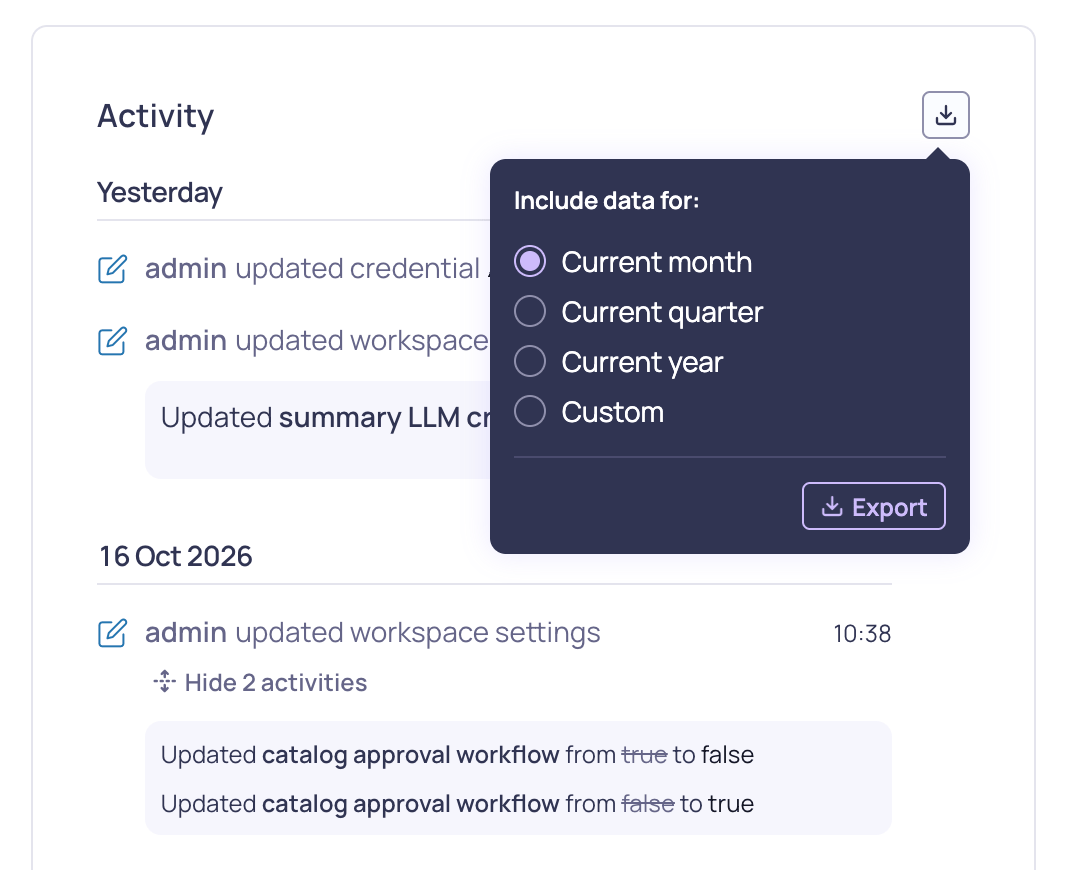
Export options for the activity log
- Click the download button in the Activity panel header.
- Pick a time range: Current month (the default), Current quarter, Current year, or Custom to enter a specific start and end date.
- Click Export.
activities-{from}_{to}.csv when the range is bounded, or activities-{today}.csv for an unbounded range. On a Source or Validator details page, the export is automatically scoped to that resource.
The export reads from the database, not the on-screen viewThe export time range is independent of what is currently loaded in the panel. You do not need to scroll to historical data before exporting — the export reads directly from the database for the range you choose.
CSV columns
For programmatic access to the same data via REST, see the CSV Export API.